
Book · Editora Simulacro · 2026
Humint Cyborg: Inteligência de Fontes Humanas em Tempos de Guerra Híbrida
Human Intelligence in Times of Hybrid Warfare
A study of what happens to human intelligence when people, relationships, identities and influence move continuously between physical and digital environments. Published in Portuguese; the English line above is an explanatory translation, not a separate edition.
Secure purchase opens in a new tab.
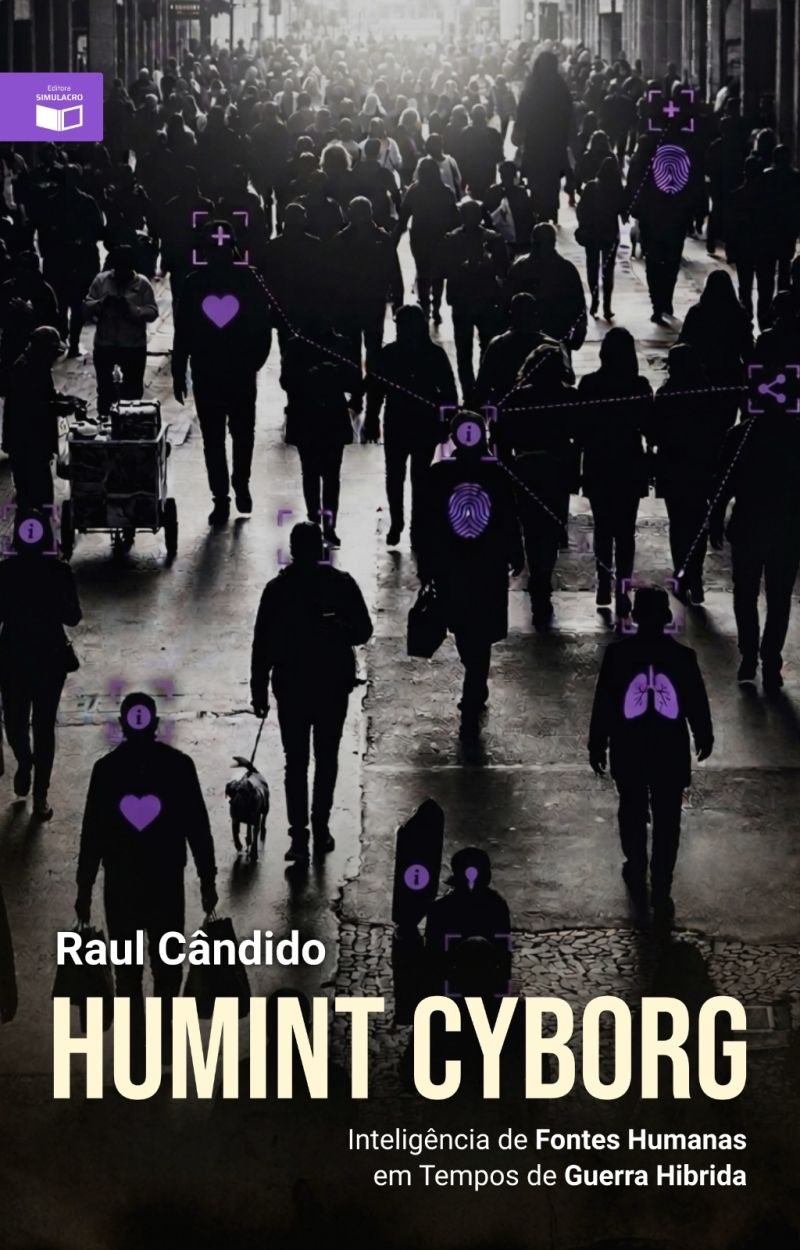
The question at the center of the book
What happens to human intelligence when people, relationships, identities, sources and influence operations move continuously between physical and digital environments?
What the book investigates
HUMINT
Human intelligence as a discipline, a method and a relationship.
HUMINT, OSINT and SOCMINT
How human, open and social-media sources complement — and contaminate — each other.
Digital identity
Profiles, personas and traces that represent — or simulate — real people.
Source assessment and corroboration
Criteria for reliability, access and consistency.
Hybrid warfare
Conflicts combining military, informational, economic and cyber means.
Disinformation and influence
Narratives, manipulation and operations targeting perception.
Cyber intelligence and the human layer
The human factor behind systems, attacks and defences.
Language and behaviour
Forensic linguistics, nonverbal behaviour and credibility.
Facts, inference and uncertainty
Separating what is known from what is inferred and what is speculation.
From the person to the cyborg
In the title, “cyborg” is not science-fiction decoration. It names the technologically mediated human: someone whose relationships, identity and capacity to influence and be influenced run through screens, platforms and networks as much as through face-to-face encounters.
For intelligence work, this changes the nature of the source. The person remains at the center — but now leaves traces, operates personas and can be reached, assessed or manipulated across overlapping environments.
Why Raul Cândido writes about this
Before writing about human sources, I spent years looking at the problem from the other side of the screen. Information security, digital investigation, cyber intelligence and open-source analysis teach us a great deal about systems, traces and data. But at some point the question stops being only what the data reveal. It becomes: who is the person behind them — and what happens when that person becomes part of the system?
Forensic linguistics taught me to treat language as evidence. Studying nonverbal behaviour and credibility analysis forced me to separate impression from method. HUMINT brought these layers together around a relationship: between the one who seeks to understand and the one who informs.
This book comes from that intersection — and from the classroom, where these questions are tested with professionals and students.
— Raul Cândido
Who this book is for
- Intelligence, international relations and geopolitics
- Cybersecurity and cyber threat intelligence (CTI)
- OSINT, SOCMINT and digital investigations
- Journalism and source verification
- Academic and research audiences
Book details
- Title
- Humint Cyborg: Inteligência de Fontes Humanas em Tempos de Guerra Híbrida
- Explanatory translation
- Human Intelligence in Times of Hybrid Warfare
- Author
- Raul Cândido
- Publisher
- Editora Simulacro
- Year
- 2026
- Foreword
- Prof. Wallace Armani
- Language
- Portuguese
- Where to get it
- Amazon
The author
Raul Cândido is the founder of Lobo Inteligência e Consultoria, a professor, an author and an expert in Computing and Forensic Linguistics. His work connects HUMINT, OSINT/SOCMINT, cyber intelligence, digital investigations, language and human behaviour.
Read the full profileTwo next steps.
Read the book, or bring the discussion to your university, course or team.
See the author's other books